
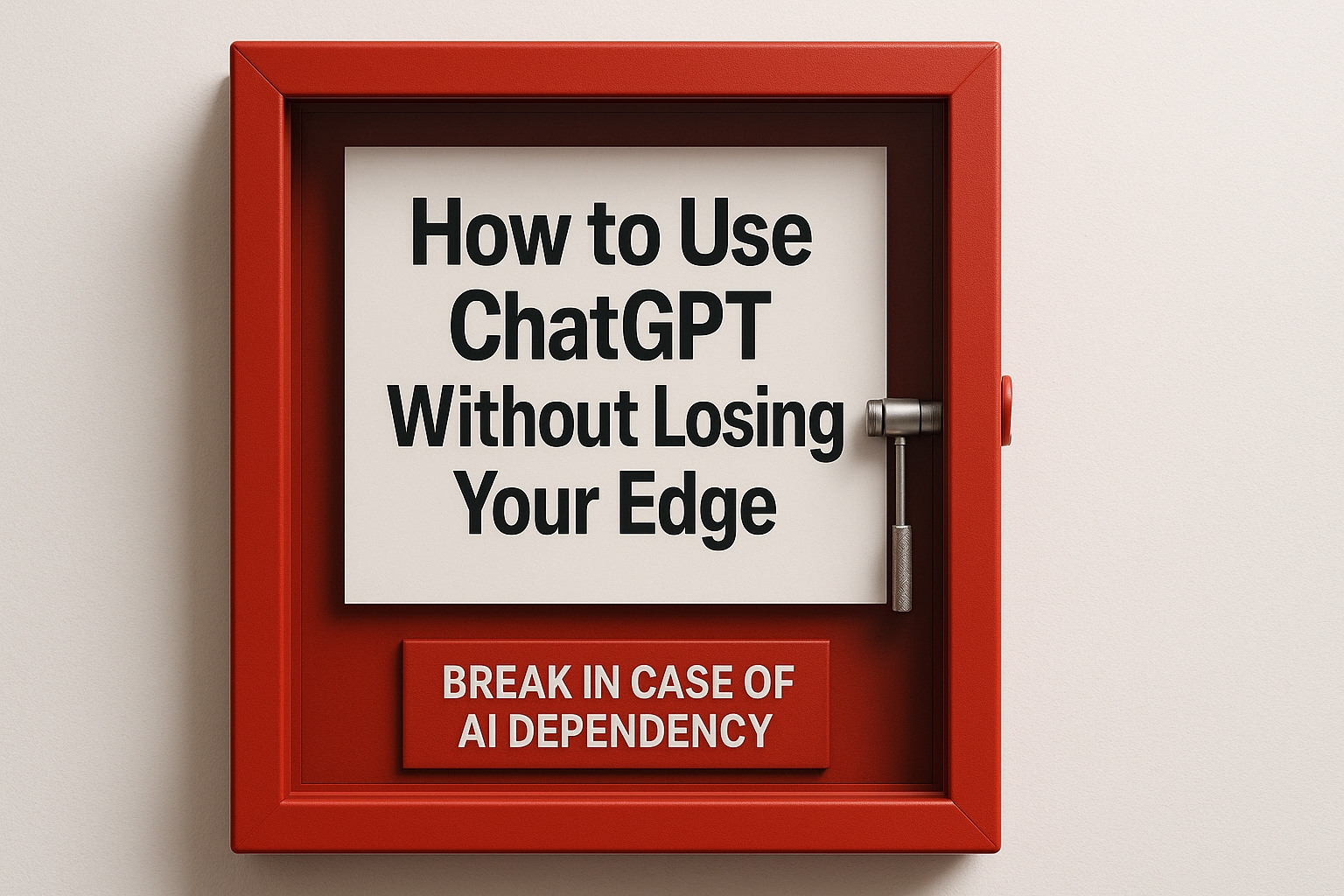
Every day, I see the same mistake: smart people letting AI do all their thinking for them.
They hand ChatGPT every email, every presentation, every brainstorm. They skip the work. AI creates from scratch, and they click “send.”
It feels efficient until the tools hit query limits. Then? Total paralysis. No outline, no starting point, no ability to think it through on their own. Just a blank screen.
That’s the danger. Used well, AI sharpens your edge and speeds you up. Used lazily, it erodes your skills, your ability to structure ideas, solve problems, and create without help.
I’ve seen it happen to executives and students alike: they become passengers in their own work.
AI should push your thinking further, not replace it. Here’s how to use ChatGPT without losing your edge.
Start Human, Finish with AI
If you start with a blank prompt, AI does all the heavy lifting. That feels good now (cue the dopamine hit), but over time, it makes you weaker.
It’s like going to the gym with a robotic exoskeleton. Sure, you can lift 500 pounds, but your actual muscles atrophy. When the machine breaks, you can’t even lift the bar.
Bad: “Write a marketing strategy for our Q4 launch.”
Good: “Here’s my rough strategy [your draft]. Challenge my assumptions about timing. What market factors am I missing?”
My process:
- Write your draft, outline, or bullet points first
- Note the key arguments or structure
- Then let AI expand, refine, and polish
- Spar with AI. Use it to make your point of view stronger
The goal isn’t efficiency, it’s intellectual partnership. You think, AI responds, you think harder.
Use AI as a Tutor, Not an Answer Machine
When you ask ChatGPT for the finished product, you bypass learning. You might sound smart in the moment, but the knowledge doesn’t stick.
I learned this the hard way when I realized I could explain AI concepts to others but couldn’t build anything from scratch myself. I was borrowing intelligence, not developing it.
Instead of: “Write a budget plan for my department” Try: “I think our biggest budget priority should be hiring, not technology. Here’s my reasoning [your analysis]. What am I missing? What would you prioritize differently?”
Instead of: “Explain why our sales dropped.” Try: “I think our sales dropped because of pricing, but I might be wrong. Here’s what I see in the data [your analysis]. What other factors should I consider?”
Better questions:
- “Walk me through the steps,” not “Give me the solution.”
- “What would happen if…” instead of “What should I do?”
- “Help me understand why this approach failed.”
Afterward, close the chat and explain the concept in your own words. That shift from product to process keeps your mind engaged and memory sharp.
Slow Down with a Simple Checklist
AI is persuasive. That’s why people copy-paste its answers without thinking. DO NOT DO THIS. The risk isn’t just errors; it’s absorbing AI’s blind spots and biases. I can tell in seconds if someone has cut and pasted an AI answer.
Before you use AI output, run a quick check:
- Accuracy: Can I verify this? (Use Perplexity for this!)
- Perspective: What’s missing from this view?
- Bias: Whose voice is this amplifying—or ignoring?
- Tone: Does this sound like me or like AI?
Say the answer out loud or jot it down again. That small pause restores critical thinking and catches the generic AI-speak that makes everything sound the same.
Recognize the Warning Signs
You’re becoming too dependent on AI when:
- You feel stuck when AI is unavailable
- You copy-paste without reading first
- You’ve lost the ability to start projects from scratch
- Your work starts sounding generic or “AI-ish”
- You find yourself asking AI to do basic tasks you used to handle easily
I see this most often with routine tasks, people asking AI to structure simple emails or format basic presentations they’ve done countless times before.
Take AI-Free Breaks
The best way to keep your skills sharp is to step away completely.
Try this:
- One project per week, no AI. Trust me on this.
- One hour daily for raw brainstorming—pen, paper, or whiteboard
- Start every creative session without AI for the first 15 minutes
Pilots still fly planes manually to keep their reflexes sharp. Professionals should do the same with thinking.
During my AI-free hour, I rediscover ideas that never would have emerged through prompts. The struggle of working through problems yourself generates insights that AI partnerships can’t replicate.
The Bottom Line
AI won’t make you irrelevant, but being unable to think without it will.
The professionals who thrive won’t be those who use AI the most, but those who use it best while keeping their intellectual edge razor-sharp. Your job isn’t to compete with AI. It’s to stay human in an automated world.
Use AI to push your thinking further, not to avoid the hard parts. Otherwise, you risk becoming the passenger while AI drives.
And passengers never learn to navigate for themselves.
Read my next article AI Strategy Framework: You Don’t Have One