
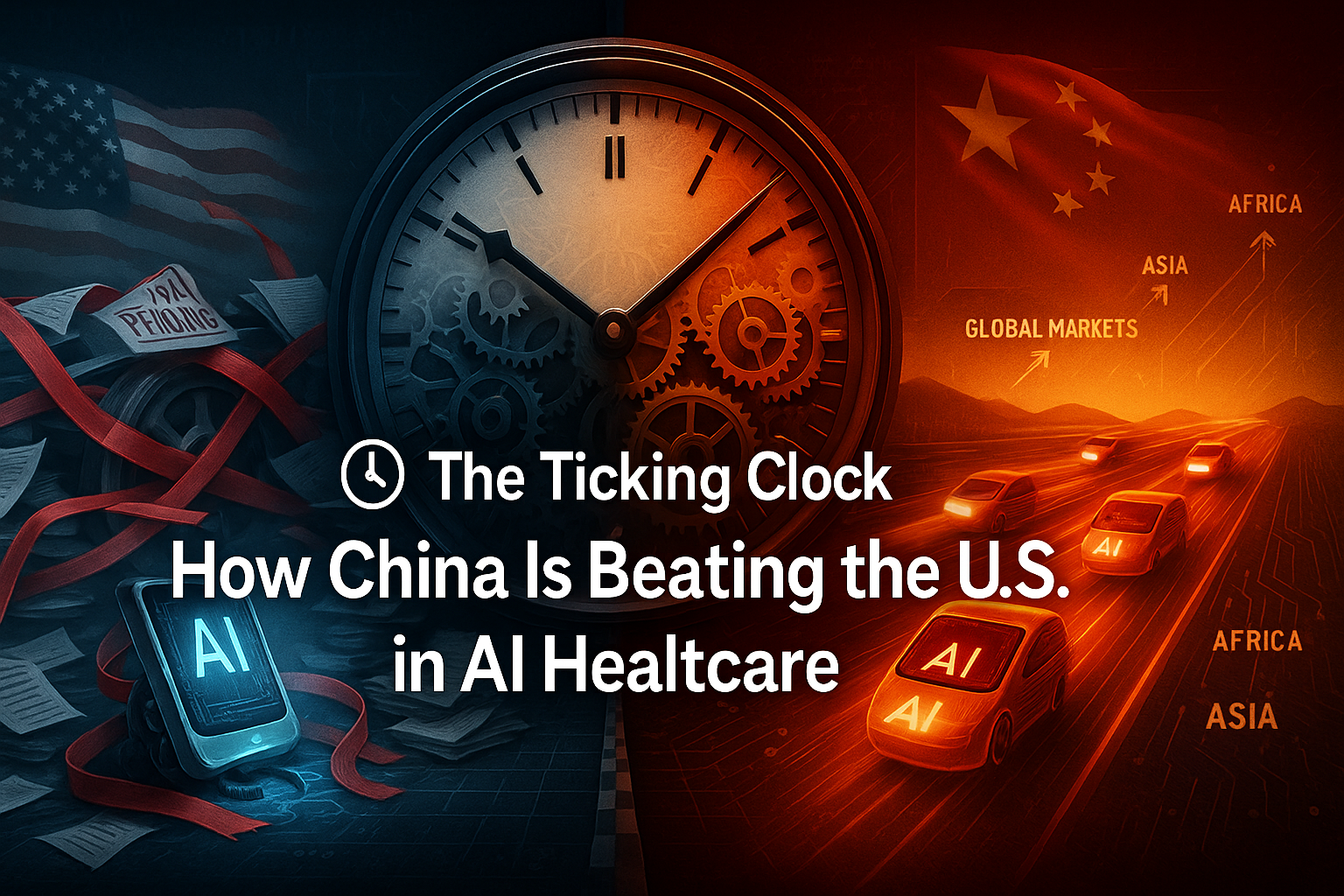
The Ticking Clock
I’ve been researching how Chinese AI healthcare companies are using our own regulatory delays against us, and the evidence is overwhelming. It’s not their technology that’s winning it’s their strategy.
Here’s what the data reveals: American pioneers developing new AI medical devices spend 34% longer, an average of 7.2 extra months in FDA approval compared to companies that come second. During those wasted months, Chinese companies are conquering markets we’re not even trying to enter.
The numbers: Chinese medical device exports to Southeast Asia jumped 25%, to Africa surged 30%, and any device approved in one ASEAN country can enter all ten CqlbbcSHINE News. They’re not seeking FDA approval because they don’t need it. They’re building an empire in markets we’ve ignored.
Think about this: The FDA has approved 521 AI devices since 1995. China started approving AI medical devices only in 2020 and had 92 advanced Class III devices approved by mid-2024. In just four years, they built a competitive ecosystem that took America nearly three decades, not by building better technology, but by choosing different battlefields entirely.
Real American companies with breakthrough innovations are watching Chinese competitors deploy similar solutions globally while they wait for FDA paperwork. We’re not losing a race. We’re not even on the same track.
The $18.8 Billion Checkmate
China’s AI healthcare market is projected to explode from $1.59 billion in 2023 to $18.88 billion by 2030, a staggering 42.5% compound annual growth rate 50+ AI in Healthcare, the highest globally. This isn’t just growth; it’s strategic positioning. While American companies navigate what the GAO calls an undefined regulatory maze, Chinese firms are executing a three-pronged strategy that should alarm every Western healthcare executive:
1. The Domestic Fortress Strategy
China’s NMPA focuses on algorithm maturity rather than the FDA’s sponsor qualification program, allowing faster domestic approvals. As of June 2024, China’s NMPA has approved 92 AI tools under Class III to accelerate healthcare decision-making, many developed by companies that didn’t exist five years ago.
The government’s “Made in China 2025” initiative explicitly allocates resources to AI healthcare, with healthcare expenditure projected to reach 16 trillion yuan by 2030.(2.2 trillion USD) This isn’t just funding, it’s a coordinated assault on Western medical technology dominance.
2. The Belt and Road Backdoor
In 2023, China’s medical device exports to Belt and Road countries grew by 22%, while exports to Southeast Asia increased by 25% and to Africa by 30%. Chinese AI medical devices aren’t competing head-to-head with American products in FDA-regulated markets; they’re circumventing them entirely.
Medical devices registered in any one of the ten ASEAN countries are allowed to enter the other nine, creating a regulatory fast-track that Chinese companies are exploiting while American firms wait for FDA approvals.
3. The Data Sovereignty Play
China has access to publicly available biodata from around the world, while its domestic datasets are closed off to other countries. This asymmetric data access creates an innovation feedback loop: Chinese AI systems train on global data while denying competitors access to the world’s largest patient population.
The Regulatory Quicksand Trap
The FDA’s approach to AI medical devices has become a case study in regulatory capture and paralysis:
- 96% of FDA-authorized AI devices use the 510(k) clearance pathway designed for devices “substantially equivalent” to existing products—a framework fundamentally incompatible with breakthrough AI innovation
- The FDA has not yet approved a device that integrates continual learning AI, only approving locked systems that can’t adapt post-deployment
- The GAO warns that FDA’s failure to identify and communicate specific legislative changes needed for AI oversight may result in falling short of developing new regulatory techniques for emerging technologies
The irony? China’s NMPA also requires “locking” algorithms, weakening AI capabilities, but they’ve accepted this tradeoff for pure speed. While we debate perfect AI governance, they’re deploying imperfect but functional AI globally. Both countries are hobbling AI’s true potential, but only China is winning markets while doing it.The Hidden Multiplier Effect
The regulatory delay creates cascading disadvantages:
Innovation Drain
Pioneer entrants in new device categories spend 34% (7.2 months) longer in approval than follow-on innovators. This first-mover disadvantage incentivizes American companies to avoid breakthrough innovation entirely.
Capital Flight
The average investment per deal in China’s healthcare AI market reached CNY 181.2 million in 2018 before cooling to CNY 69 million in 2020, but this “cooling” masks a strategic shift from venture funding to state support through the National AI Industry Investment Fund’s ¥60 billion war chest.
Market Capture Through Standards
Chinese ambitions to set AI standards at a global level make being part of early AI discussions in China crucial for companies’ global success. While the FDA debates frameworks, China is writing the rules.
The Tencent-Alibaba-Baidu Triangle
Ant Group’s new AI-powered healthcare app uses large language models from DeepSeek, Alibaba, and Ant, with plans for global expansion. Tencent obtained a Class III medical device license for its pneumonia CT imaging software, becoming the first internet company in China to obtain a Class III AI medical license.
These aren’t traditional medical device companies; they’re tech giants with:
- Billions in capital
- Massive data repositories
- Direct access to 1.4 billion consumers
- State backing and protection
The Uncomfortable Truth
New FDA regulations are expected to result in a reduction in AI-enabled medical device approvals in the short term, as manufacturers must adhere to stricter rules that are both time-consuming and costly. This regulatory tightening, while aimed at safety, hands Chinese competitors an even larger window of opportunity.
The Strategic Response
American policymakers and healthcare executives face three uncomfortable options:
Option 1: Regulatory Revolution. Create a separate fast-track pathway for AI medical devices that acknowledges their fundamental difference from traditional devices. The current 510(k) framework is like regulating jets with horse-and-buggy rules.
Option 2: Strategic Coupling. Global pharma giants, including Roche and AstraZeneca are partnering with Chinese AI startups for biomarker discovery. If you can’t beat them, joint venture with them before they no longer need you.
Option 3: Market Segmentation Concede certain markets to Chinese dominance while building regulatory walls around core Western markets. This managed retreat preserves some competitive space but acknowledges the new reality.
The Clock Is Running
By 2028, China’s AI healthcare market will reach approximately US$16.02 billion, larger than most European countries’ entire healthcare IT sectors. Every month of regulatory delay isn’t just lost revenue; it’s surrendered territory in the battle for AI healthcare supremacy.
The question isn’t whether Chinese AI healthcare companies are using regulatory arbitrage as a competitive weapon. They are, brilliantly and systematically. The question is whether American regulators and companies will recognize this strategic threat before the game is already over.
Healthcare is the canary in the coal mine. The same playbook of regulatory arbitrage, market circumvention, data asymmetry, and state support will be deployed across every AI vertical where safety regulations create friction. Finance, autonomous vehicles, and industrial AI` all face the same strategic vulnerability.
The China Card isn’t coming. It’s already been played. The only question is whether the West understands the game being played before it’s too late to respond.
Read my next article – How to use ChatGPT without losing your edge.