
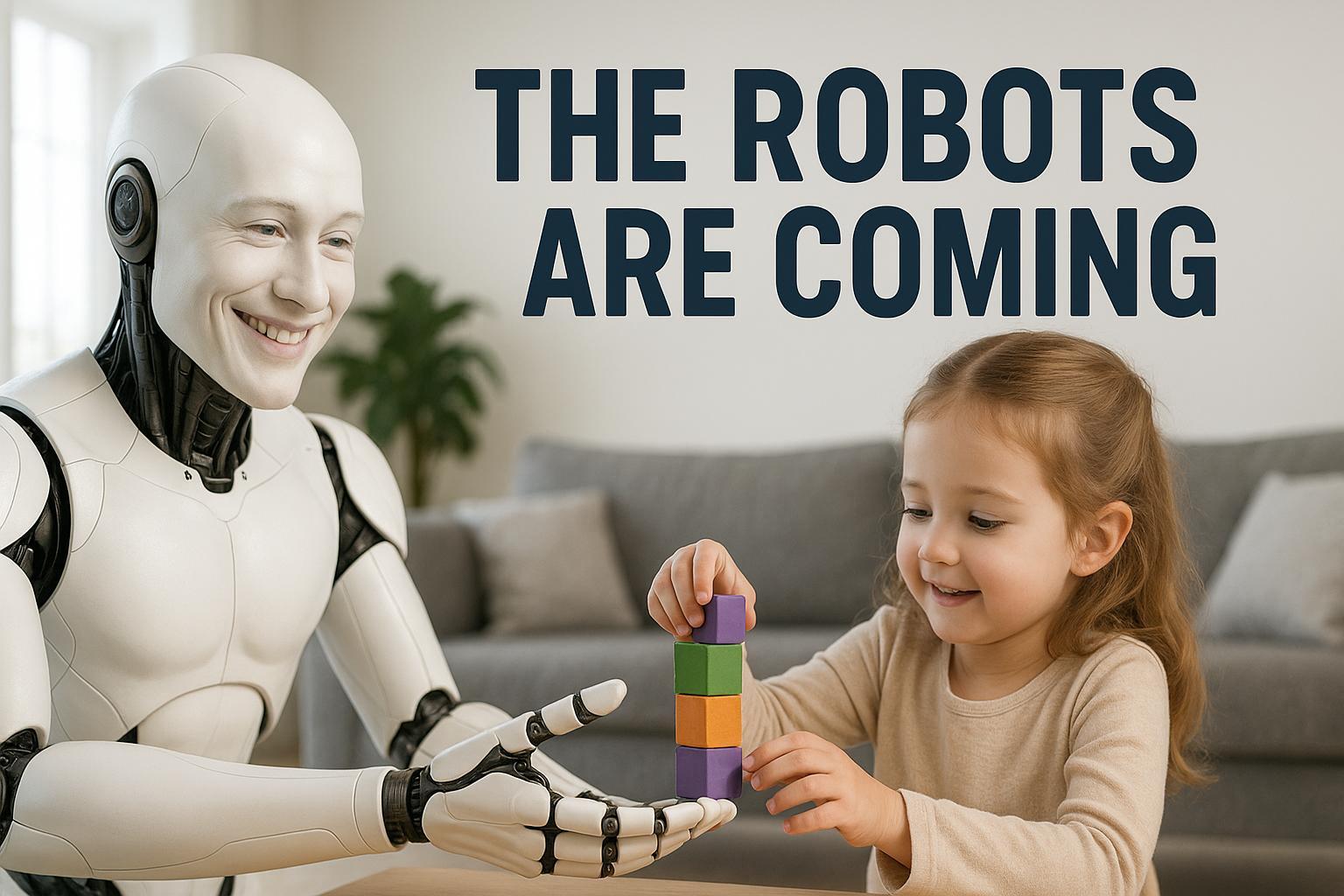
My son wants a robot. He’s been seeing all the robot videos on YouTube and reading articles on them everywhere. So, as any good parent does and to explain to him what Physical AI is, I researched what’s out there now and what our robotic future will look like. I’m hoping to live like a Jetson!
I started with Tesla and found a video of a humanoid robot sorting battery cells in Tesla’s Fremont factory. Not in a demo. Not in a lab. In an actual production facility, doing actual work, right now. Pretty cool!
This is Physical AI, the marriage of artificial intelligence with robotics, sensors, and real-world systems. It’s already here, transforming our world in ways most people haven’t noticed yet.
What does Elon Musk say about Robots? He predicts that Optimus robots could generate over $10 trillion in revenue long-term, potentially becoming the most valuable part of Tesla’s business. That’s not a typo. Ten. Trillion. Dollars.
But Physical AI isn’t just about Tesla’s robots. Recent advances in artificial intelligence, vision systems, and robotics hardware are enabling a new generation of more intelligent and adaptable machines. We’re witnessing the birth of an entirely new technology category that will fundamentally reshape both work and home life.
And I need to tell you: it’s going to be both incredible and terrifying. Personally, I am hoping for the incredible, especially when I am 85 and need a robot to do the things I can’t.
What Physical AI Actually Is (And Why It’s Different This Time)
Physical AI isn’t your Roomba getting smarter, although mine could use it. NVIDIA defines it as the use of vision-language-action models that can guide a robot’s decisions and movements. Think of it as AI escaping the confines of your screen and entering the tangible world. It sees, understands, and acts in real-time.
Physical AI relies on a mix of neural graphics, synthetic data generation, physics-based simulation, reinforcement learning, and AI reasoning. Unlike traditional robots programmed for repetitive tasks, these systems learn, adapt, and make decisions autonomously.
The Next 5 Years: Your Workplace Is About to Get Weird
Work Transformation
Forget everything you think you know about industrial automation. Tesla aims to produce several thousand Optimus humanoid robots in 2025, with plans to scale to 50,000-100,000 units by 2026 and approximately 500,000 units annually by 2027. Here comes iRobot!
But it’s not just Tesla. In 2025, $1.2 trillion in investments toward building out U.S. production capacity was announced, led by electronics providers, pharmaceutical companies, and semiconductor manufacturers. Everyone wants work robots.
Manufacturing floors will look radically different:
- Collaborative robots (“cobots”) working alongside humans
- AI-powered quality control catching defects humans miss
- Autonomous warehouse systems that never sleep
- Agricultural robots managing crops with millimeter precision
Early adopters like Amazon and Foxconn are already seeing significant benefits, including improved efficiency, faster delivery times, and the creation of new skilled jobs.
Home Revolution
Your home is about to become sentient. And I mean that literally.
1X has announced NEO, the world’s first consumer-ready humanoid robot designed to transform life at home, automating everyday chores and offering personalised assistance.
In five years, expect:
- Domestic robots that do more than vacuum. Think laundry folding, dishwasher loading, basic cooking (Who couldn’t use that?)
- AI health monitoring through wearables and smart home sensors
- Eldercare assistants who never take a break
Smart home systems can tell the difference between someone bending to pick something up and someone falling. They know if a noise is just a pot dropping in the kitchen or something more serious, like breaking glass from an intrusion.
Captions are auto generated
The Eldercare Game-Changer
Here’s where it gets personal. The AI-powered solutions segment within elderly care is expected to achieve a CAGR of approximately 9.73% from 2025 to 2030, reaching a market value of around USD 2250 million by 2030.
AI-integrated smart sensors provide real-time monitoring and automated support through a smooth, non-intrusive approach to monitoring elders’ health and activity. These systems can:
- Detect falls before they happen through gait analysis
- Monitor medication compliance automatically
- Alert caregivers to behavioral changes indicating health issues
- Provide companionship through AI assistants
My own grandmother used to struggle with taking her medication on schedule. The future promises AI systems that not only remind but physically dispense medications at the right time, monitor if they’re taken, and alert doctors if something’s wrong.
The 10-Year Horizon: When Robots Become Colleagues and Companions
At Work: The Rise of Generalist Robots
By 2035, we won’t just have specialized robots. We’ll have multi-skilled, “generalist” machines capable of:
- Learning new tasks without reprogramming
- Collaborating creatively with human workers
- Making complex decisions independently
- Managing other robots in coordinated teams
Breakthroughs in hardware, artificial intelligence, and vision systems are giving rise to robotic systems capable of perception, reasoning, and autonomous action.
At Home: Your Personal Robot Butler
Musk predicts that by 2040, the number of humanoid robots could surpass the human population. While that seems extreme, the trajectory is clear.
Within a decade, expect:
- Humanoid robots as household helpers (think a physical version of Jarvis from Iron Man)
- AI-augmented prosthetics that adapt to users’ intentions
- Homes that anticipate needs before you express them
- Robot caregivers providing 24/7 support for elderly or disabled individuals
The Dark Side: What Should Terrify You
This is what keeps me up at night.
Job Displacement Is Real
AI automation has the potential to disrupt industries and replace certain job roles, leading to job displacement and economic challenges. According to the World Economic Forum’s Future of Jobs 2025 report, robotics and autonomous systems will be major sources of job displacement.
While new jobs will emerge, the transition won’t be smooth for everyone. Manufacturing workers, warehouse employees, and even some service industry professionals face an uncertain future.
Cybersecurity Nightmares
As more systems, such as autonomous vehicles, manufacturing equipment, and medical systems, adopt AI, the risk to physical safety can increase. An AI-based self-driving car that suffers a cybersecurity breach could pose a risk to its passengers’ physical safety.
Imagine a hacked humanoid robot in your home. Or compromised industrial robots causing “accidents” in factories. The attack surface is expanding exponentially. Again, I am channeling the movie iRobot.
The Inequality Gap
As with a lot of tech, there will he the haves and have-nots. Prenuvo charges from $2,500 for health scans, while Neko offers similar AI-powered services for £299. This massive price differential exists today. What happens when life-extending Physical AI is only available to the wealthy? I do believe prices will come down over time, but the question is, how long will this take.
Why This Time Really Is Different
I’ve covered enough “revolutionary” technologies to be skeptical. But Physical AI has something previous robot revolutions lacked: convergence.
Recent breakthroughs have pushed key enabling technologies past the threshold of usability. We now have:
- Vision systems that actually work
- AI that can reason about physical space
- Batteries that last all day
- Computing power at the edge
- Manufacturing capacity ready to scale
NVIDIA is actively supporting open standards and integrating GPU-aware abstractions directly into robotics frameworks, enabling high-speed performance. When the infrastructure players go all-in, you know it’s real.
The Bottom Line: Prepare or Be Prepared
Physical AI is here. Tesla’s Optimus is already performing tasks autonomously in factories. Google, NVIDIA, and dozens of startups are racing to deploy their solutions.
The question isn’t whether Physical AI will transform your life, but how quickly and dramatically. Will you be among those who adapt and thrive, or those caught flat-footed by the change? I want one when they are ready.
As I watch that robot sorting battery cells in Tesla’s factory, I’m reminded of something: every industrial revolution created more prosperity than it destroyed. But the transition periods were brutal for those who didn’t adapt.
Physical AI represents the fourth industrial revolution’s physical manifestation. It’s not just changing what machines can do, it’s redefining what it means to work, to age, to live.
Three Questions to Ask Yourself:
How will you ensure your parents (or yourself) benefit from AI eldercare rather than being left behind?
If a robot could do 50% of your job tomorrow, what would make you irreplaceable?
Are you ready for robots as neighbors, not just tools?